

-
1 потери холостого хода
потери холостого хода
Активная мощность, потребляемая трансформатором при номинальном напряжении (или напряжении ответвления) и номинальной частоте на выводах одной из обмоток при разомкнутых остальных обмотках
(МЭС 421-06-01).
Примечание — Значения этих параметров должны быть отнесены к основному ответвлению, если в НД не указано другое ответвление.
[ ГОСТ 30830-2002]
потери холостого хода
потери х. х.
Потери, возникающие в трансформаторе в режиме холостого хода при номинальном напряжении и номинальной частоте
[ ГОСТ 16110-82]EN
no-load loss
the active power absorbed when a given voltage at rated frequency is applied to the terminals of one of the windings, the other winding(s) being open-circuited
NOTE – Normally the applied voltage is the rated voltage and the energized winding, if fitted with tappings, is connected on its principal tapping
[IEV number 421-06-01]FR
pertes à vide
puissance active absorbée quand une tension donnée à la fréquence assignée est appliquée aux bornes de l'un des enroulements, l'autre (ou les autres) enroulement(s) étant à circuit ouvert
NOTE – Normalement, la tension appliquée est la tension assignée et l'enroulement d'excitation, s'il est muni de prises, est connecté sur sa prise principale.
[IEV number 421-06-01]Тематики
Классификация
>>>Синонимы
- потери х. х.
EN
DE
FR
Русско-немецкий словарь нормативно-технической терминологии > потери холостого хода
-
2 входное полное сопротивление
входное полное сопротивление
-
[IEV number 312-06-18]EN
input impedance
impedance of the input circuit measured between the input terminals under operating conditions
NOTE 1 – The impedance can be expressed in terms of admittance.
NOTE 2 – In certain instances, for example, sampling devices or self-balancing potentiometers, the impedance can be different according to the instant when it is determined, before, during or after the instant of measurement.
NOTE 3 – When the input circuit is such that the instantaneous value of the current flowing into the input terminals is a non-linear function of the instantaneous value of the input voltage under specified conditions of frequency and voltage, the combination of resistance and reactance which would absorb the same active power and in which would flow a reactive current equal to the fundamental component that is flowing in the actual input circuit, is sometimes called the "equivalent input impedance".
[IEV number 312-06-18]FR
impédance du circuit d'entrée
impédance du circuit d'entrée entre les bornes d'entrée dans les conditions de fonctionnement
NOTE 1 – L'impédance peut être exprimée en termes d'admittance.
NOTE 2 – Dans certains cas, par exemple les dispositifs d'échantillonnage ou les potentiomètres à rééquilibrage automatique, l'impédance peut être différente selon l’instant où elle est déterminée, avant, pendant ou après la mesure.
NOTE 3 – Lorsque le circuit d'entrée est tel que la valeur instantanée du courant traversant les bornes d'entrée est une fonction non linéaire de la valeur instantanée de la tension d'entrée dans des conditions spécifiées de fréquence et de tension, l'impédance d'une combinaison formée par une résistance et une réactance qui absorberaient la même puissance active et dans laquelle circulerait un courant réactif égal à la composante fondamentale qui circule dans le circuit d'entrée réel, est parfois appelée "impédance équivalente d'entrée".
[IEV number 312-06-18]Тематики
- измерение электр. величин в целом
EN
DE
FR
Русско-немецкий словарь нормативно-технической терминологии > входное полное сопротивление
-
3 выходное полное сопротивление
выходное полное сопротивление
-
[IEV number 312-06-19]EN
output impedance
impedance of the output circuit measured between the output terminals under operating conditions
NOTE 1 – The impedance can be expressed in terms of admittance.
NOTE 2 – In certain instances, for example, sampling devices or self-balancing potentiometers, the impedance can be different according to the instant when it is determined, before, during or after the instant of measurement.
NOTE 3 – When the output circuit is such that the instantaneous value of the current flowing into the output terminals is a non-linear function of the instantaneous value of the output voltage under specified conditions of frequency and voltage, the combination of resistance and reactance which would absorb the same active power and in which would flow a reactive current equal to the fundamental component that is flowing in the actual output circuit, is sometimes called the "equivalent output impedance".
[IEV number 312-06-19]FR
impédance du circuit de sortie
impédance du circuit de sortie entre les bornes de sortie dans les conditions de fonctionnement
NOTE 1 – L'impédance peut être exprimée en termes d'admittance.
NOTE 2 – Dans certains cas, par exemple les dispositifs d'échantillonnage ou les potentiomètres à rééquilibrage automatique, l'impédance peut être différente selon l’instant où elle est déterminée, avant, pendant ou après la mesure.
NOTE 3 – Lorsque le circuit de sortie est tel que la valeur instantanée du courant traversant les bornes de sortie est une fonction non linéaire de la valeur instantanée de la tension de sortie dans des conditions spécifiées de fréquence et de tension, l'impédance d'une combinaison formée par une résistance et une réactance qui absorberaient la même puissance active et dans laquelle circulerait un courant réactif égal à la composante fondamentale qui circule dans le circuit de sortie réel, est parfois appelée "impédance équivalente de sortie".
[IEV number 312-06-19]Тематики
- измерение электр. величин в целом
EN
DE
FR
Русско-немецкий словарь нормативно-технической терминологии > выходное полное сопротивление
-
4 добротность
добротность
1. Количественная характеристика потерь колебательной системы при резонансе, равная
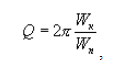
где Wк - полный запас энергии колебаний при резонансе;
Wп - потери энергии за период
[ Физический энциклопедический словарь]
2. Количественная мера потерь колебательной системы. Показывает, во сколько раз амплитуда вынужденных колебаний при резонансе превышает амплитуду на частоте, много меньшей резонансной при одинаковой внешней силе
3. Отношение резонансной частоты спектра колебаний к его ширине на уровне 0,707 от максимального значения амплитуды спектра
Примечание
Определения 2 и 3 являются достаточно точными для систем с высокой добротностью (Q >(5-10)), определение 1 пригодно во всех случаях
[Система неразрушающего контроля. Виды (методы) и технология неразрушающего контроля. Термины и определения (справочное пособие). Москва 2003 г.]
добротность (1)
коэффициент добротности (1)
-
[IEV number 151-15-45]
добротность (2)
коэффициент добротности (2)
-
[IEV number 151-15-46]EN
quality factor (1)
Q factor (1)
for a capacitor or inductor under periodic conditions, ratio of the absolute value of the reactive power to the active power
NOTE 1 – The quality factor is a measure of the losses, usually unwanted, in a capacitor or an inductor.
NOTE 2 – The quality factor depends generally on frequency and voltage.
[IEV number 151-15-45]
quality factor (2)
Q factor (2)
for a resonant circuit at the resonance frequency, 2π times the ratio of the maximum stored energy to the energy dissipated during one period
NOTE – The quality factor is a measure of sharpness of the resonance.
Source: 801-24-12 MOD
[IEV number 151-15-46]FR
facteur de qualité (1), m
facteur de surtension (1), m
pour un condensateur ou une bobine d'inductance en régime périodique, rapport de la valeur absolue de la puissance réactive à la puissance active
NOTE 1 – Le facteur de qualité caractérise les pertes, généralement non désirées, dans un condensateur ou une bobine d'inductance.
NOTE 2 – Le facteur de qualité dépend généralement de la fréquence et de la tension.
[IEV number 151-15-45]
facteur de qualité (2), m
facteur de surtension (2), m
pour un circuit résonant fonctionnant à la fréquence de résonance, 2π fois le rapport de l'énergie maximale emmagasinée dans le circuit à l'énergie dissipée pendant une période
NOTE – Le facteur de qualité caractérise l'acuité de la résonance.
Source: 801-24-12 MOD
[IEV number 151-15-46]Синонимы
EN
DE
FR
Русско-немецкий словарь нормативно-технической терминологии > добротность
-
5 компенсация реактивной мощности
компенсация реактивной мощности
-EN
reactive power compensation
an action to optimize the transmission of reactive power in the network as a whole
[МЭС 603-04-28]FR
compensation de l'énergie réactive
action dont le but est d'optimiser globalement le transport d'énergie réactive dans le réseau
[МЭС 603-04-28]Параллельные тексты EN-RU
Reactive energy management
In electrical networks, reactive energy results in increased line currents for a given active energy transmitted to loads.
The main consequences are:
• Need for oversizing of transmission and distribution networks by utilities,
• Increased voltage drops and sags along the distribution lines,
• Additional power losses.
This results in increased electricity bills for industrial customers because of:• Penalties applied by most utilities on reactive energy,
• Increased overall kVA demand,
• Increased energy consumption within the installations.
Reactive energy management aims to optimize your electrical installation by reducing energy consumption, and to improve power availability.
Total CO2 emissions are also reduced.
Utility power bills are typically reduced by 5 % to 10 %.
[Schneider Electric]Компенсация реактивной мощности
Передача по электрической сети реактивной энергии приводит к увеличению линейных токов (по сравнению токами, протекающими при передаче нагрузкам только активной энергии).
Основные последствия этого явления:
● необходимость увеличения сечения проводников в сетях передачи и распределения электроэнергии;
● повышенное падение и провалы напряжения в распределительных линиях;
● дополнительные потери электроэнергии;
Для промышленных потребителей такие потери приводят к возрастанию расходов на оплату электроэнергии, что вызвано:● штрафами, накладываемыми поставщиками электроэнергии за избыточную реактивную мощность;
● увеличением потребления полной мощности (измеряемой в кВА);
● повышенным энергопотреблением электроустановок.Цель компенсации реактивной мощности (КРМ) – оптимизация работы электроустановки за счет сокращения потребления энергии и увеличения надежности электроснабжения. Кроме того, КРМ позволяет уменьшить выбросы CO2 и сократить расходы на электроэнергию в среднем на 5-10 %.
[Перевод Интент]Наиболее эффективным способом снижения потребляемой из сети реактивной мощности является применение установок компенсации реактивной мощности (конденсаторных установок).
Использование конденсаторных установок позволяет:- разгрузить питающие линии электропередачи, трансформаторы и распределительные устройства;
- снизить расходы на оплату электроэнергии;
- при использовании определенного типа установок снизить уровень высших гармоник;
- подавить сетевые помехи, снизить несимметрию фаз;
- увеличить надежность и экономичность распределительных сетей.
На практике коэффициент мощности после компенсации находится в пределах от 0,93 до 0,99.
Наибольший экономический эффект достигается при размещении компенсирующих устройств вблизи электроприемников, потребляющих реактивную мощность.
Различают следующие виды компенсации:-
индивидуальная (нерегулируемая) компенсация
Целесообразна, если мощность электроприемника больше 20 кВт и потребляемая мощность постоянна в течение длительного времени.
Компенсирующая нерегулируемая установка подключается непосредственно у потребителя. Как правило, применяется для компенсации реактивной мощности таких потребителей, как мощные компрессоры, вентиляторы и насосы, силовые трансформаторы. - групповая (нерегулируемая) компенсация
- централизованная компенсация
Для ламп типа ДРЛ, ДРИ, ДРИЗ, ДНаТ может применяться как групповая, так и индивидуальная компенсация реактивной мощности
[ПУЭ]Тематики
Синонимы
Сопутствующие термины
- конденсатор компенсации реактивной мощности
- конденсаторная батарея компенсации реактивной мощности
- контроллер компенсации реактивной мощности
- недостаточная компенсация реактивной мощности
- перекомпенсация реактивной мощности
- потребляемая реактивная мощность
- ступень компенсации реактивной мощности
- установка КРМ
- устройства динамической компенсации реактивной мощности
EN
- energy compensation
- management of reactive energy
- power factor compensation
- reactive energy management
- reactive power compensation
DE
FR
Русско-немецкий словарь нормативно-технической терминологии > компенсация реактивной мощности
См. также в других словарях:
active voltage — aktyvioji įtampa statusas T sritis automatika atitikmenys: angl. active voltage vok. Wirkspannung, f rus. активное напряжение, n pranc. tension active, f … Automatikos terminų žodynas
active voltage — aktyvioji įtampa statusas T sritis fizika atitikmenys: angl. active voltage vok. Wirkspannung, f rus. активное напряжение, n pranc. tension active, f … Fizikos terminų žodynas
Voltage-to-current converter — Introduction For a variety of reasons, in low voltage electronics, voltage is a more frequently used data carrier. Thus electronic devices tend to be labeled with voltage inputs and outputs. However some devices are labeled in terms of current… … Wikipedia
Active rectification — is a technique for improving efficiency of Diode Bridge rectifiers. It consists of replacing a diode with a transistor (usually a power MOSFET). Applications In Full Bridge Rectifiers, the voltage drop of a diode (typically around 0.7V for a… … Wikipedia
Voltage-dependent calcium channel — Voltage dependent calcium channels (VDCC) are a group of voltage gated ion channels found in excitable cells (e.g., muscle, glial cells, neurons, etc.) with a permeability to the ion Ca2+.[1][2] These channels are slightly permeable to sodium… … Wikipedia
Active dynamic filtering — Active dynamic filtering, ADF, is a three phase power electronics based power flow control technology that can effectively be used to isolate and remove electrical behaviours that cause excess losses and disruptions in the electrical… … Wikipedia
Active power conditioner — (active power filters) refers to power electronic devices that are used in industry or commercial facilities to improve electrical power quality and remove behaviours that cause losses and disruptions, such as harmonics, reactive power, flicker… … Wikipedia
Active matrix addressing — is an addressing scheme used in video displays. Given a m times; n matrix, the number of connectors needed to address the display is m + n .Each pixel is attached to a switch device, which actively maintains the pixel state while other pixels are … Wikipedia
Voltage regulator — A popular three pin 12 V DC voltage regulator IC. A voltage regulator is an electrical regulator designed to automatically maintain a constant voltage level. A voltage regulator may be a simple feed forward design or may include negative feedback … Wikipedia
Active load — An active or dynamic load is a component or a circuit behaving as a current stable nonlinear resistor. This term may refer to a component of circuit design, or to a type of test equipment. Contents 1 Circuit design 1.1 Common base example 1.2… … Wikipedia
Active pixel sensor — An active pixel sensor (APS) is an image sensor consisting of an integrated circuit containing an array of pixel sensors, each pixel containing a photodetector and an active amplifier. There are many types of active pixel sensors including the… … Wikipedia
